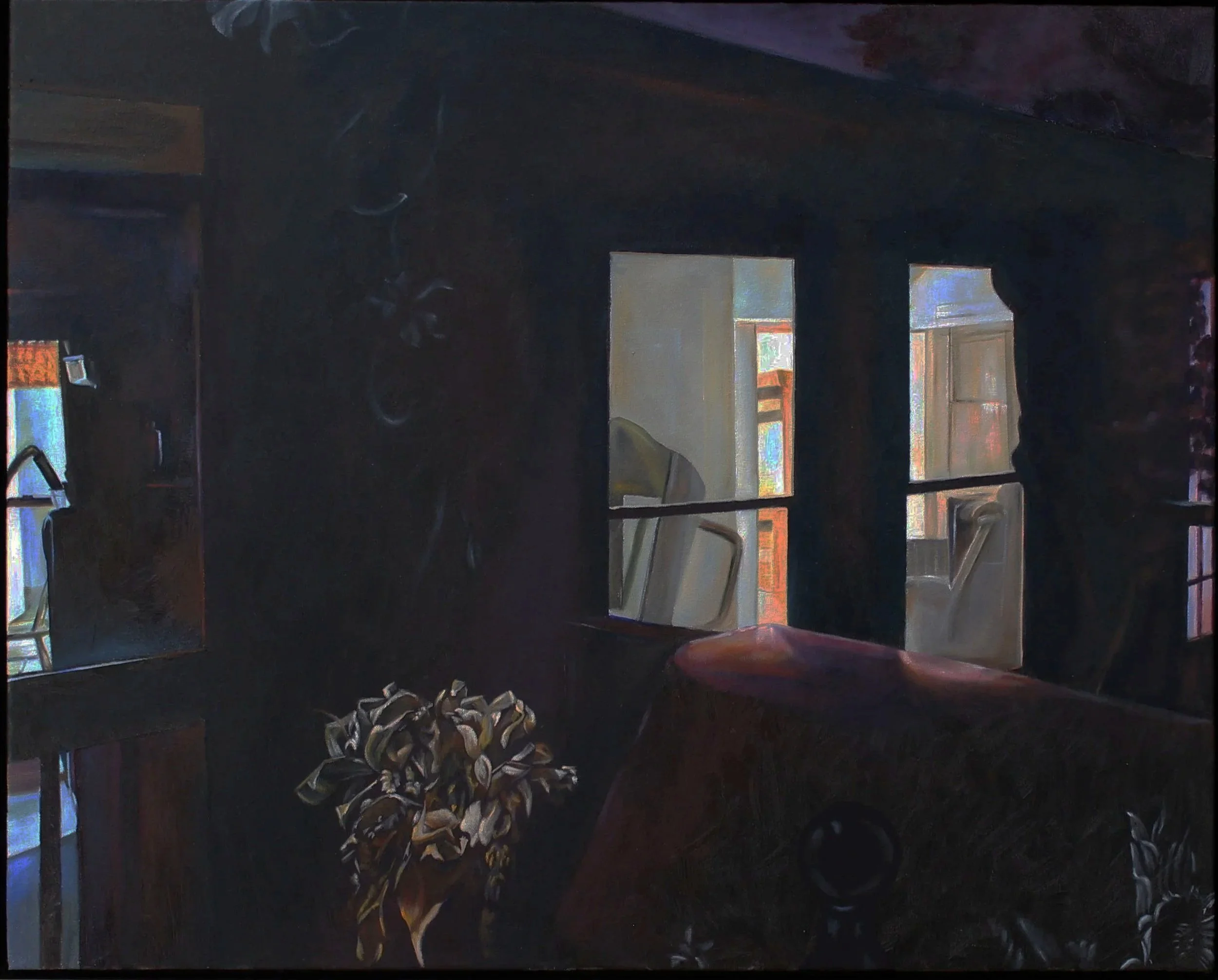
I first began using windows in my early figurative drawings such as Back of Woman (1975) and Seated Woman (1975). In those works, the inhabited interior is lit while the window opens onto a dark, nighttime exterior. Later, in Porter School (1979), a pastel drawing of a view through a window, both the inside and outside are illuminated. Even then, I was questioning the kind of awareness and introspection that arises when looking through glass — how windows and mirrors create a threshold where inward and outward perception interpenetrate.
In Outback at Night (2024), I wanted the surrounding darkness to invite the natural imagination we feel when objects recede into obscurity. Yet I resisted letting the lit interiors beyond the windows become an emotional refuge. I wanted those spaces left undefined, withholding the usual sense of safety or clarity. Instead, the dried flowers resting in the darkness carry the emotional weight of the painting; they are the point of attention, the quiet presence that anchors the viewer in the shadowed space.
This sense of insecurity echoes my intentions in Inside/Outside – Outside/Inside, where the view through glass offers only fragments of objects and partial glimpses of real space. The faint suggestion of a reflected figure in that painting parallels the barely discernible forms in the darkness of Outback at Night. The illuminated window areas provide multiple registers of visual information — each color carrying its own emotional temperature, each interior a separate but unreachable world.
Outback at Night belongs to my ongoing series of nighttime paintings, including Doorway at Night (2023), where darkness becomes both a setting and a psychological field.