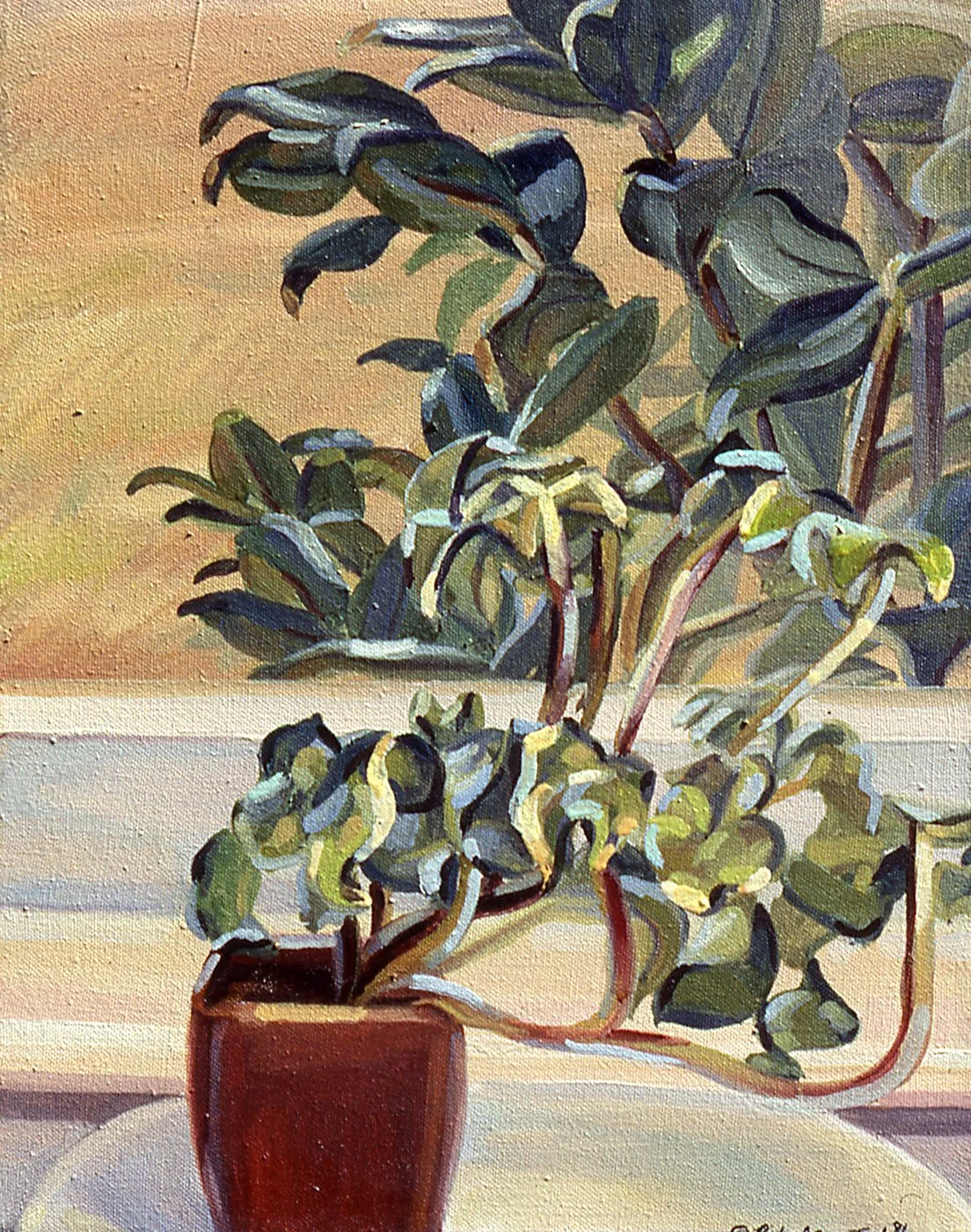
When I painted Leaves Inside and Outside (1981), my attention was fixed on how natural light moves across ordinary objects in everyday surroundings. A potted ivy sits on a stool before the window, its leaves catching the shifting interior light while the outdoor foliage rises beyond the sill in warm, muted tones. At the time, I was deep into my Ivy Series, exploring how ivy—and plant life more broadly—invites a kind of active visual curiosity. The forms move through space, the surfaces gather and release light, and in doing so they help define the emotional atmosphere of a room.
As I worked through these paintings, I realized I was already navigating the boundaries of a fragmented world—one we respond to instinctively even if we rarely acknowledge it. Ivy leaves, with their particular sensitivity to color and light, stirred an emotional response that reminded me of what abstract expressionists must have felt as they spilled color and gesture across a surface. I remember the immediacy of the moment: the ivy, the window sill, the rising leaves outside. That interplay of interior and exterior space carried a charge that stayed with me.
Looking back at images of the painting now, I feel something akin to what I experienced standing before Willem de Kooning’s Woman at the Weatherspoon Art Gallery during my internship—an encounter with a surface alive with tension, presence, and shifting perception. Leaves Inside and Outside marks an early point in my ongoing exploration of interior and exterior boundaries, an inquiry that continued throughout my career and later resurfaced in works such as Inside/Outside – Outside/Inside (2021).