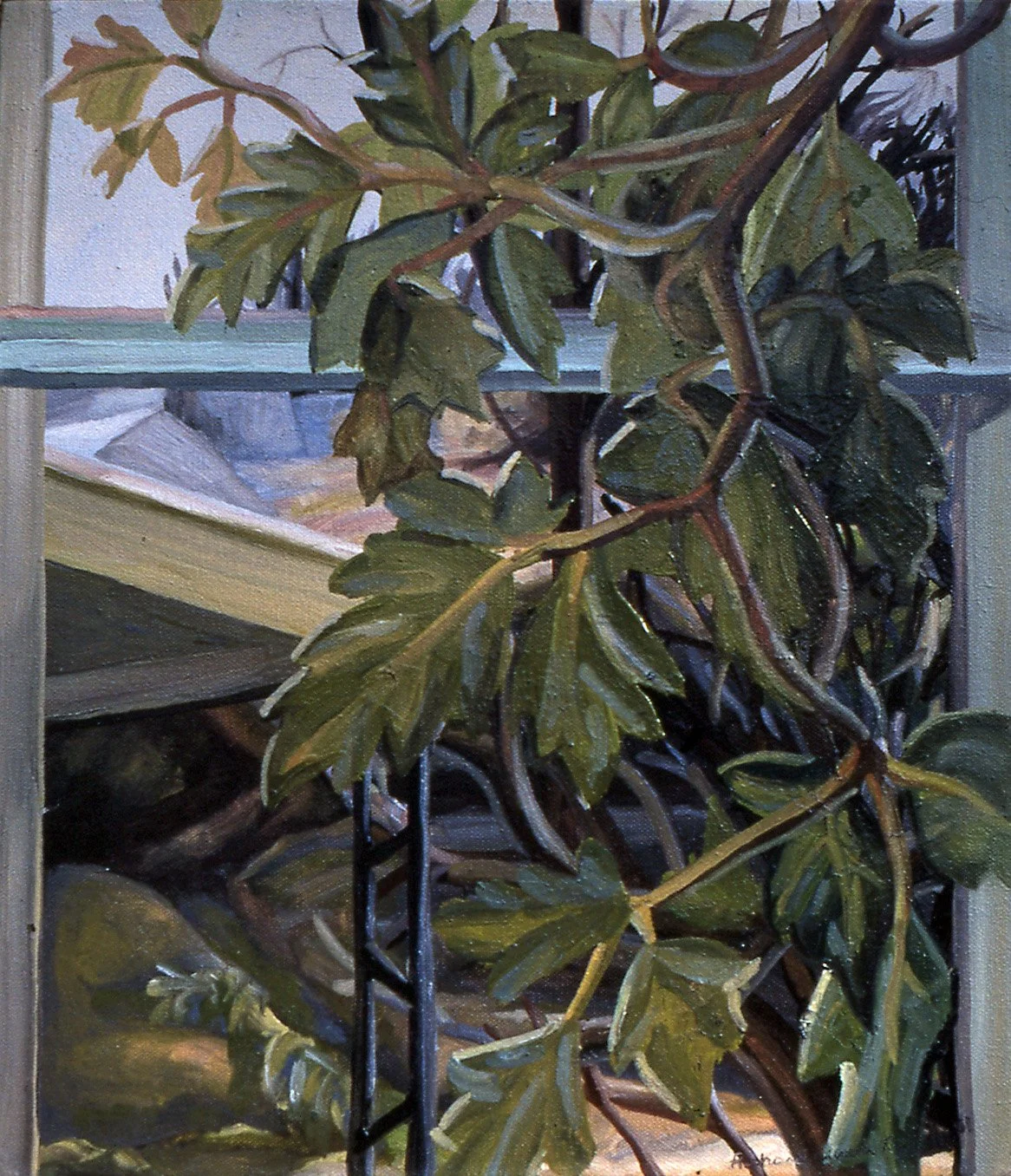
When I painted Ivy and Outdoors (1980), I was beginning to understand how the ivy in my Legacy Ivy Series could carry emotional weight beyond their quiet presence in interior space. I had long been drawn to the way English ivy vines enliven a room—how they catch light, how they interact with nearby objects, how they subtly shift the atmosphere. We bring them indoors for that reason. But when they become the center of focus, they take on their own emotional significance.
In this painting, the ivy becomes a counterpoint to what lies beyond the window. The outside world is present but less defined—recognizable elements like the porch roof edge, the roofline of a house, and the receding ground appear almost as suggestions. The window frame becomes the threshold, the dividing line between interior presence and outward longing. I realized here that the ivy could hold that tension: the desire to look outward, the quiet pull of what lies beyond.
Although I had explored monochrome atmospheres in earlier works, I had not yet brought my modernist or impressionist instincts fully into the Ivy Series. Ivy and Outdoors remains rooted in traditional naturalism, yet the atmospheric blues—so central to several indoor ivy paintings—begin to emerge. They soften the space, giving the ivy a luminous presence against the more subdued outdoor forms.
Plants, and ivy in particular, invite an emotional awareness of space. They hover between structure and softness, between presence and suggestion. Glass surfaces do something similar. Much later, in Inside/Outside – Outside/Inside (2021) and other reflective-surface works, I returned to this idea of thresholds—how a pane of glass can hold two worlds at once. Ivy and Outdoors (1980) was one of the first steps toward that exploration.