 Image 1 of 1
A turning‑point drawing where figure, space, and surface begin to share equal authority
In Woman Leaning Left (1976) I was only days away from making Woman Leaning Right, yet the two drawings reveal different priorities emerging almost simultaneously. This work benefits from the surface precision that pencil drawing on hard‑pressed rag paper makes possible—an exactness of contour, pressure, and tonal shift that shaped my entire 1976 series.
Unlike the later drawings where I cropped the head to shift attention toward abstracted form, here I chose to show the entire figure, including the face. This decision connects the drawing to earlier works from 1975—such as Woman Sitting Indian Style—where the figure had more conventional breathing room around it. But in Woman Leaning Left, I began to understand that the figure and background could merge, allowing the picture surface itself to become more active and perceptually charged.
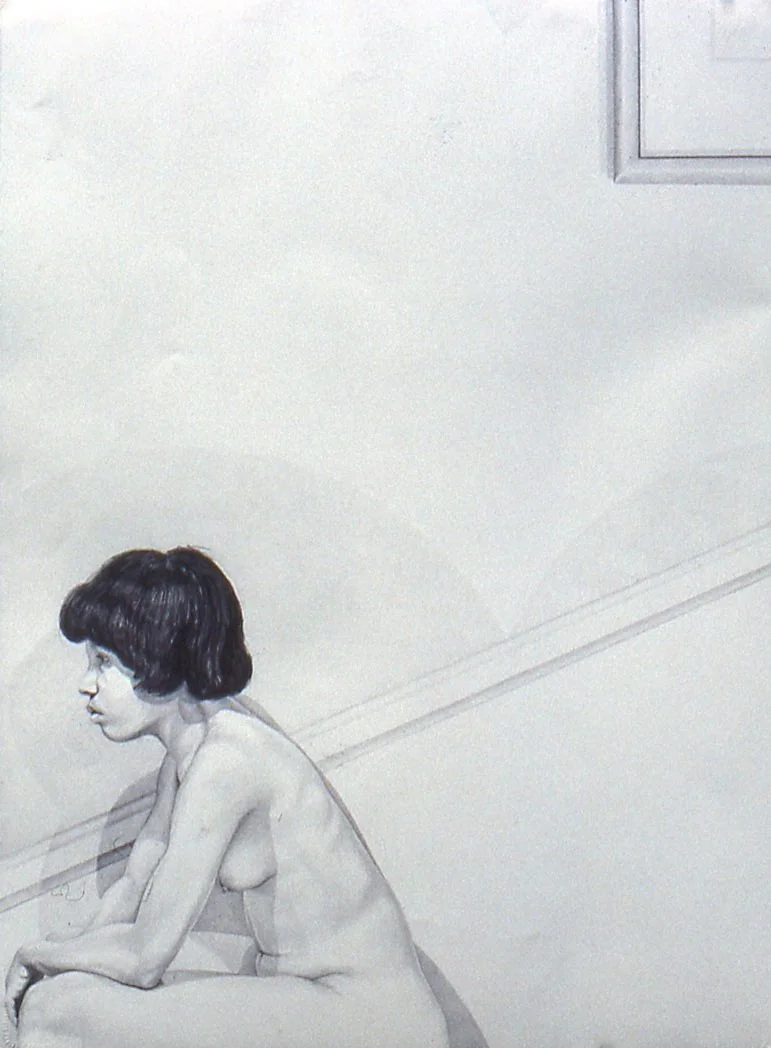
The strong diagonal behind the figure implies she is seated on a stair, while the curving wall shape introduces a flat, contoured form that contrasts visually against her leaning body. These elements create a subtle tension: the body is soft and weighted, while the background asserts itself as a geometric presence. The sharp corner of a picture frame at the upper right, pointing toward her, interrupts what might otherwise be a calm pose. It introduces a slight disturbance—a continuation of my early my interest in how spatial intrusions shape psychological atmosphere.
In this drawing, the human face returns as a point of attention, yet the figure is also treated as an object in space, and the space as an object in relation to the figure. This equal priority—figure as object, space as object—marks the beginning of a shift that would define much of my later work.
· Dimensions: 22″ × 30″
· Medium: Pencil drawing
· Framing: Custom-framed by me to complement my specific painting
aesthetic.
Notice: This image has been modified for public viewing.
A turning‑point drawing where figure, space, and surface begin to share equal authority
In Woman Leaning Left (1976) I was only days away from making Woman Leaning Right, yet the two drawings reveal different priorities emerging almost simultaneously. This work benefits from the surface precision that pencil drawing on hard‑pressed rag paper makes possible—an exactness of contour, pressure, and tonal shift that shaped my entire 1976 series.
Unlike the later drawings where I cropped the head to shift attention toward abstracted form, here I chose to show the entire figure, including the face. This decision connects the drawing to earlier works from 1975—such as Woman Sitting Indian Style—where the figure had more conventional breathing room around it. But in Woman Leaning Left, I began to understand that the figure and background could merge, allowing the picture surface itself to become more active and perceptually charged.
The strong diagonal behind the figure implies she is seated on a stair, while the curving wall shape introduces a flat, contoured form that contrasts visually against her leaning body. These elements create a subtle tension: the body is soft and weighted, while the background asserts itself as a geometric presence. The sharp corner of a picture frame at the upper right, pointing toward her, interrupts what might otherwise be a calm pose. It introduces a slight disturbance—a continuation of my early my interest in how spatial intrusions shape psychological atmosphere.
In this drawing, the human face returns as a point of attention, yet the figure is also treated as an object in space, and the space as an object in relation to the figure. This equal priority—figure as object, space as object—marks the beginning of a shift that would define much of my later work.
· Dimensions: 22″ × 30″
· Medium: Pencil drawing
· Framing: Custom-framed by me to complement my specific painting
aesthetic.
Notice: This image has been modified for public viewing.