 Image 1 of 1
A pastel where Impressionist technique becomes a bridge between seeing and feeling
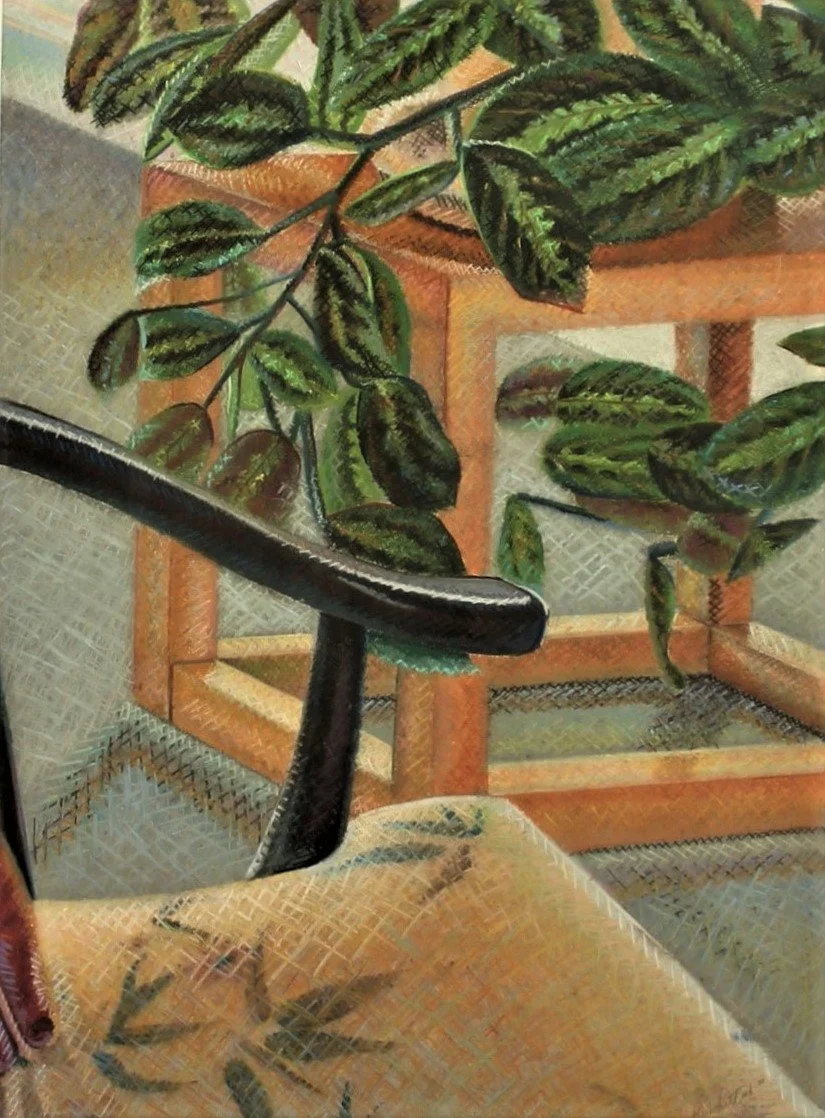
In Prayer Plant (1987) I was using pastel to return to a question that had followed me for years: How do I mediate the space between what I see and what I place on the picture surface? Pastel, with its immediacy and textured luminosity, let me explore that boundary more directly than oil sometimes allowed. I was thinking again about the useful qualities of Impressionist technique — how broken color, small shifts in value, and quick strokes can make light feel alive rather than merely described.
The highlight on the edge of the black chair arm, slipping just beneath the leaves of the prayer plant, became a kind of revelation. Looking back from later works like Woman in a Mirror, I can see how that tiny glint “hits a visual homeplace.” It’s the kind of overlooked shimmer we miss when we move through a room, but when we truly look — into a scene, or into another person’s eyes — that same flicker becomes charged with meaning.
The prayer plant itself, with its patterned leaves and shifting posture, gave me a subject where light, intimacy, and attention could meet. The pastel strokes let the leaves breathe, while the chair arm’s highlight grounded the composition in lived space. The drawing became a meditation on how small visual truths can carry emotional weight, and how the act of looking transforms the ordinary into something quietly resonant.
Dimensions: 22″ × 30″
Medium: Oil pastels
A pastel where Impressionist technique becomes a bridge between seeing and feeling
In Prayer Plant (1987) I was using pastel to return to a question that had followed me for years: How do I mediate the space between what I see and what I place on the picture surface? Pastel, with its immediacy and textured luminosity, let me explore that boundary more directly than oil sometimes allowed. I was thinking again about the useful qualities of Impressionist technique — how broken color, small shifts in value, and quick strokes can make light feel alive rather than merely described.
The highlight on the edge of the black chair arm, slipping just beneath the leaves of the prayer plant, became a kind of revelation. Looking back from later works like Woman in a Mirror, I can see how that tiny glint “hits a visual homeplace.” It’s the kind of overlooked shimmer we miss when we move through a room, but when we truly look — into a scene, or into another person’s eyes — that same flicker becomes charged with meaning.
The prayer plant itself, with its patterned leaves and shifting posture, gave me a subject where light, intimacy, and attention could meet. The pastel strokes let the leaves breathe, while the chair arm’s highlight grounded the composition in lived space. The drawing became a meditation on how small visual truths can carry emotional weight, and how the act of looking transforms the ordinary into something quietly resonant.
Dimensions: 22″ × 30″
Medium: Oil pastels