 Image 1 of 1
A transitional work where a playful idiom, a spotlight, and a miniature figurine open the door to the Glass Figurine series
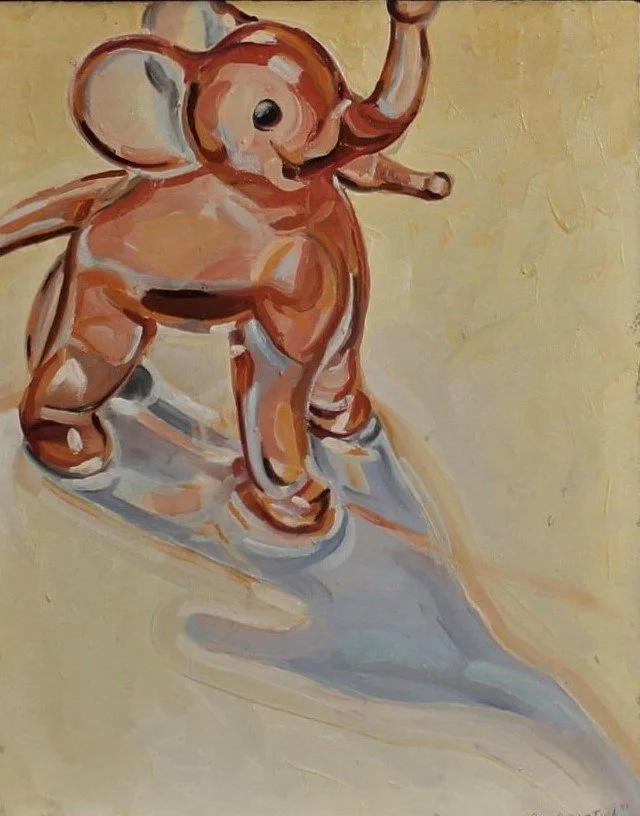
In Pink Glass Elephant (1981) I was standing at the threshold of what would become the Glass Figurines series. I had already been painting everyday objects with a kind of heightened attention, but the glass animal miniatures offered something different — a chance to let scale, humor, and light bend the ordinary into something slightly uncanny.
The phrase “pink elephants” floated into my mind early on. It was a playful idiom, a bit of cultural shorthand for the fanciful or absurd, and it gave the miniature a conceptual lift — a way to let this tiny glass creature step into a larger imaginative space. I wanted to see whether these small figurines, usually dismissed as decorative trinkets, could carry a touch of Pop Art glamour, the same way a soup can or a comic panel could be elevated by attention and scale.
When I placed the actual pink elephant under a spotlight, the transformation began. Its cast shadow stretched forward across the surface, echoing the long, reaching shadows in earlier works like Cookies, Dark and Light Mugs, and Beer Mug and Wine Glass. Those shadows had always suggested more than simple illumination — they carried a sense of time, distance, and a subtle psychological charge.
Here, the shadow did something similar. It elongated the miniature’s presence, giving it a kind of stage, a sense of arrival. It also brought to mind the early 20th‑century surrealists, whose long shadows and tilted spaces stretched reality just enough to make it feel dreamlike. This painting isn’t surrealist, but it shares that impulse to let the familiar slip slightly out of its expected frame.
In Pink Glass Elephant, the miniature grew a bit, but its identity expands more. Light, shadow, and cultural reference combine to give it a presence far larger than its physical size — a first step toward the more ambitious enlargements and psychological explorations that would follow in the later figurine paintings.
· Dimensions: 16″ × 20″
· Medium: Oil on canvas
· Framing: Custom-framed by me to complement my specific painting aesthetic.
A transitional work where a playful idiom, a spotlight, and a miniature figurine open the door to the Glass Figurine series
In Pink Glass Elephant (1981) I was standing at the threshold of what would become the Glass Figurines series. I had already been painting everyday objects with a kind of heightened attention, but the glass animal miniatures offered something different — a chance to let scale, humor, and light bend the ordinary into something slightly uncanny.
The phrase “pink elephants” floated into my mind early on. It was a playful idiom, a bit of cultural shorthand for the fanciful or absurd, and it gave the miniature a conceptual lift — a way to let this tiny glass creature step into a larger imaginative space. I wanted to see whether these small figurines, usually dismissed as decorative trinkets, could carry a touch of Pop Art glamour, the same way a soup can or a comic panel could be elevated by attention and scale.
When I placed the actual pink elephant under a spotlight, the transformation began. Its cast shadow stretched forward across the surface, echoing the long, reaching shadows in earlier works like Cookies, Dark and Light Mugs, and Beer Mug and Wine Glass. Those shadows had always suggested more than simple illumination — they carried a sense of time, distance, and a subtle psychological charge.
Here, the shadow did something similar. It elongated the miniature’s presence, giving it a kind of stage, a sense of arrival. It also brought to mind the early 20th‑century surrealists, whose long shadows and tilted spaces stretched reality just enough to make it feel dreamlike. This painting isn’t surrealist, but it shares that impulse to let the familiar slip slightly out of its expected frame.
In Pink Glass Elephant, the miniature grew a bit, but its identity expands more. Light, shadow, and cultural reference combine to give it a presence far larger than its physical size — a first step toward the more ambitious enlargements and psychological explorations that would follow in the later figurine paintings.
· Dimensions: 16″ × 20″
· Medium: Oil on canvas
· Framing: Custom-framed by me to complement my specific painting aesthetic.