 Image 1 of 1
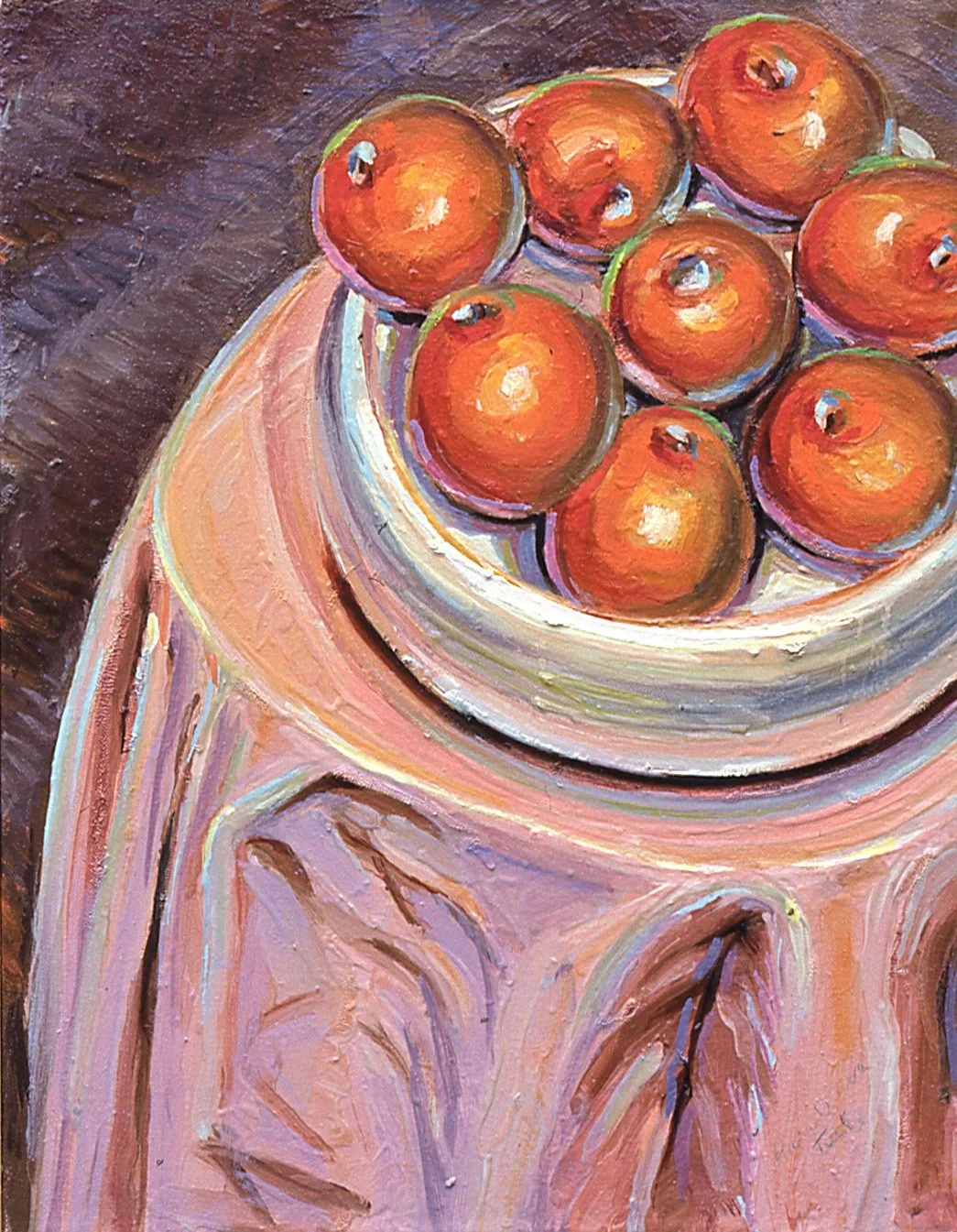
Orange in Bowl (1982)
Viewed from above, Orange in Bowl belongs to the same perceptual inquiry that shaped Varied Fare Still Life: the decision to look down at everyday objects so their forms flatten, their silhouettes sharpen, and their edges carry more of the visual burden. That vantage point compresses space, yet I wanted the color and paint surface to push back—to restore a sense of volume so that contour and mass work together, not against one another, to hold both visual and emotional weight.
Rather than approaching the painting as an abstract exercise in inventing marks, I let the objects themselves dictate the brushwork. Light falling across the bowl and fruit asked for a response; the strokes emerged from that encounter, not from a contrived system. This is where the post‑impressionist break with perceptual convention—Cézanne, Matisse, and others—opened a path for me. Their willingness to dismantle restrictive realism and reimagine how form is built on the canvas created a zone of freedom I found compelling.
In Orange in Bowl, that influence led me to look more closely, to choreograph the subject with intention, and to let the everyday object become a site where perception, paint, and modernist inquiry meet.
Medum: oil on canvas
Dimensions: 14×18”
Orange in Bowl (1982)
Viewed from above, Orange in Bowl belongs to the same perceptual inquiry that shaped Varied Fare Still Life: the decision to look down at everyday objects so their forms flatten, their silhouettes sharpen, and their edges carry more of the visual burden. That vantage point compresses space, yet I wanted the color and paint surface to push back—to restore a sense of volume so that contour and mass work together, not against one another, to hold both visual and emotional weight.
Rather than approaching the painting as an abstract exercise in inventing marks, I let the objects themselves dictate the brushwork. Light falling across the bowl and fruit asked for a response; the strokes emerged from that encounter, not from a contrived system. This is where the post‑impressionist break with perceptual convention—Cézanne, Matisse, and others—opened a path for me. Their willingness to dismantle restrictive realism and reimagine how form is built on the canvas created a zone of freedom I found compelling.
In Orange in Bowl, that influence led me to look more closely, to choreograph the subject with intention, and to let the everyday object become a site where perception, paint, and modernist inquiry meet.
Medum: oil on canvas
Dimensions: 14×18”