A still life that questions the “rules” of realism by letting everyday objects behave the way they do in real life — unexpectedly
In Orange & Cruet (1982) I was working inside the same vein as Cheese Platter, Openers, and the other small works from that period when my attention was fixed on the tactile pleasure of fluid, buttery paint. These paintings weren’t simply about depicting objects; they were about feeling paint move, letting the material assert itself as strongly as the subject.
Traditional still‑life painting has long relied on familiar objects — fruit, vessels, tableware — and with that tradition comes a set of trite expectations. Realistic art is often asked to behave: to be orderly, composed, balanced, obedient to genre. But our actual experience of the everyday world is rarely that tidy. Things sit at odd angles, drift toward the edge, feel slightly haphazard.
This painting leans into that truth.
The cruet tipping across the top edge breaks the conventional frame of still‑life composition. It echoes the sensibility behind my earlier Objects on the Edge works, where objects flirt with imbalance, as if caught in a moment of real‑world placement rather than studio arrangement. The orange anchors the scene, but the cruet’s precarious position introduces a subtle tension — a reminder that the everyday is full of small instabilities.
In this series, the materiality of paint and the unpredictability of ordinary objects work together. The paint is lush, physical, almost sculptural; the composition is slightly off‑kilter. Both resist the polished expectations of traditional realism and instead point toward a more lived, observed, and imperfect experience of the world.
A still life that questions the “rules” of realism by letting everyday objects behave the way they do in real life — unexpectedly
In Orange & Cruet (1982) I was working inside the same vein as Cheese Platter, Openers, and the other small works from that period when my attention was fixed on the tactile pleasure of fluid, buttery paint. These paintings weren’t simply about depicting objects; they were about feeling paint move, letting the material assert itself as strongly as the subject.
Traditional still‑life painting has long relied on familiar objects — fruit, vessels, tableware — and with that tradition comes a set of trite expectations. Realistic art is often asked to behave: to be orderly, composed, balanced, obedient to genre. But our actual experience of the everyday world is rarely that tidy. Things sit at odd angles, drift toward the edge, feel slightly haphazard.
This painting leans into that truth.
The cruet tipping across the top edge breaks the conventional frame of still‑life composition. It echoes the sensibility behind my earlier Objects on the Edge works, where objects flirt with imbalance, as if caught in a moment of real‑world placement rather than studio arrangement. The orange anchors the scene, but the cruet’s precarious position introduces a subtle tension — a reminder that the everyday is full of small instabilities.
In this series, the materiality of paint and the unpredictability of ordinary objects work together. The paint is lush, physical, almost sculptural; the composition is slightly off‑kilter. Both resist the polished expectations of traditional realism and instead point toward a more lived, observed, and imperfect experience of the world.
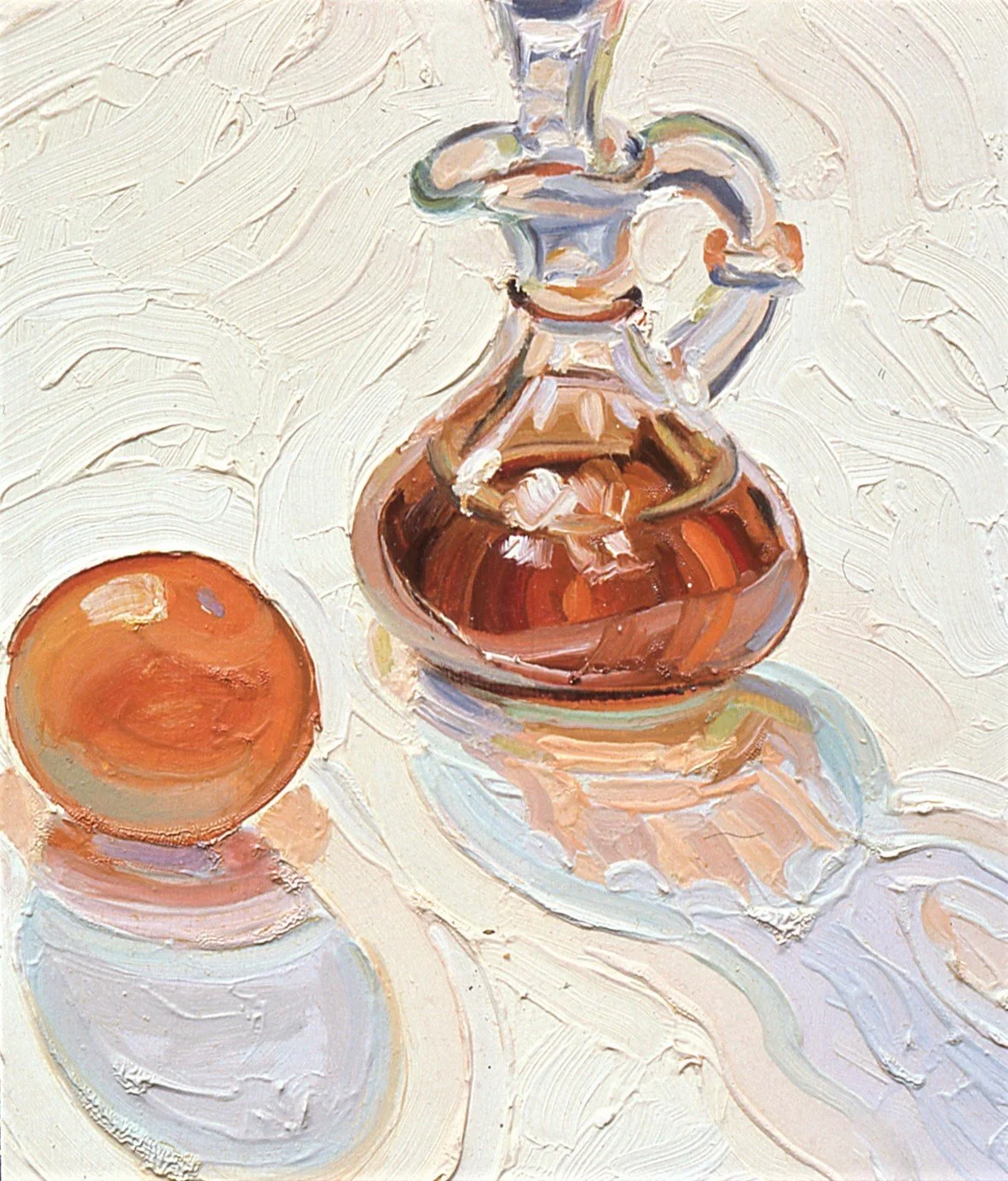 Image 1 of 1