A small painting where personal meaning overtakes Pop culture’s spectacle
In Green Tomato (1980) I found myself thinking back to a brief exchange I’d had as a student with Marjorie Strider, whose work was rooted in the bold language of Pop Art. The movement was already well established, and its visual punch certainly had appeal, but I realized that my own instincts pulled me in a different direction. Rather than engaging with popular culture or media imagery, I felt a stronger connection to everyday objects — things that carried personal resonance rather than cultural commentary.
The green tomato itself became the anchor for that realization. I was taken by its fleshy, bulbous form, perched right at the edge of a shelf corner. Its rounded top faces downward toward the viewer, almost as if it’s bowing while simultaneously standing proudly, propped up by the short remnant of its stem. That physical stance — humble yet assertive — was part of its charm.
What gives the painting its charge is the strong red background, which pushes the tomato forward with a kind of Pop exuberance, even though the subject is rooted in my own private world rather than mass culture. The contrast between the tomato’s cool green flesh and the insistent red field behind it creates a visual tension that feels both intimate and bold.
This small work marks an early moment when I understood that I could borrow the energy of Pop without adopting its subject matter. The tomato becomes a stand‑in for the everyday objects that have always mattered to me — modest, familiar, and quietly expressive.
Part of Objects on the Edge Series
A small painting where personal meaning overtakes Pop culture’s spectacle
In Green Tomato (1980) I found myself thinking back to a brief exchange I’d had as a student with Marjorie Strider, whose work was rooted in the bold language of Pop Art. The movement was already well established, and its visual punch certainly had appeal, but I realized that my own instincts pulled me in a different direction. Rather than engaging with popular culture or media imagery, I felt a stronger connection to everyday objects — things that carried personal resonance rather than cultural commentary.
The green tomato itself became the anchor for that realization. I was taken by its fleshy, bulbous form, perched right at the edge of a shelf corner. Its rounded top faces downward toward the viewer, almost as if it’s bowing while simultaneously standing proudly, propped up by the short remnant of its stem. That physical stance — humble yet assertive — was part of its charm.
What gives the painting its charge is the strong red background, which pushes the tomato forward with a kind of Pop exuberance, even though the subject is rooted in my own private world rather than mass culture. The contrast between the tomato’s cool green flesh and the insistent red field behind it creates a visual tension that feels both intimate and bold.
This small work marks an early moment when I understood that I could borrow the energy of Pop without adopting its subject matter. The tomato becomes a stand‑in for the everyday objects that have always mattered to me — modest, familiar, and quietly expressive.
Part of Objects on the Edge Series
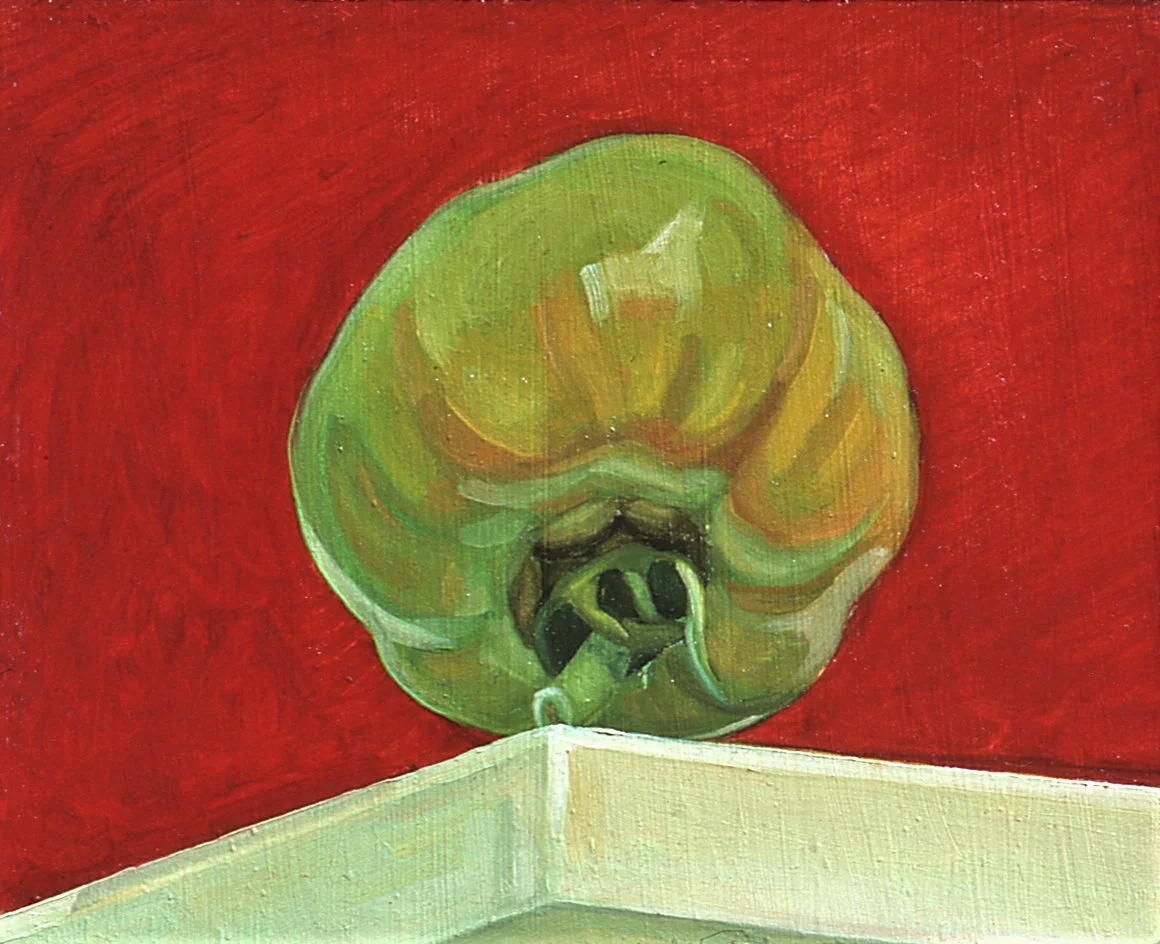 Image 1 of 1