 Image 1 of 1
Human fragments, Pop interruption, and the early emergence of glass as a reflective presence
When I painted Man’s Torso and Glass Owl, I had only begun using glass objects in my work. Later, glass would become a recurring subject—both as a mirror and as a way of expanding the life of a scene. Champagne Glass and Glass Mug are examples of an early focus that later became more focused. But here, as in Figure at Hips, I was immersed in my exploration of human fragments—showing only portions of the body to invite closer inspection and more personal associations.
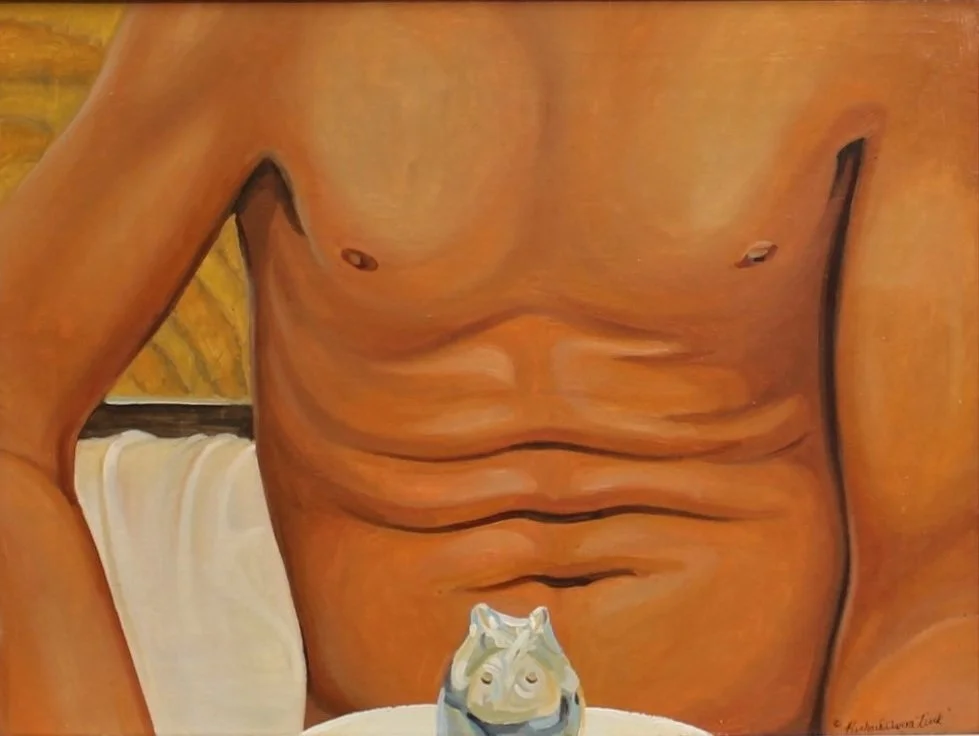
This direct, frontal view of a man’s chest presents the richness of human flesh while elevating what might otherwise be an unremarkable or even uninviting midsection. The small glass owl—a simple paperweight only about three inches tall—echoes that Pop sensibility. Its rounded body and tiny eyes catch the blue and blue‑green reflections of the room, along with the warm orange tones of the figure’s skin.
The curving folds of the abdomen and the downward tilt of the upper chest create a face‑like suggestion, with the nipples subtly repeating the owl’s small, bright eyes. The torso fills nearly the entire space, except for a narrow opening beneath the slightly bent right arm. Through that gap, the folds of a white cloth introduce a contrasting visual rhythm and deepen what is otherwise a shallow space.
At the bottom edge, the owl breaks into the frame, revealing only the back edge of the stool it rests on. The figure remains the subject, but the owl interrupts any projection of seriousness—an intentional, playful disruption.
Dimensions: 18″ × 24″
Medium: Oil on canvas
Framing: Custom-framed by me to
complement my specific
painting aesthetic
Human fragments, Pop interruption, and the early emergence of glass as a reflective presence
When I painted Man’s Torso and Glass Owl, I had only begun using glass objects in my work. Later, glass would become a recurring subject—both as a mirror and as a way of expanding the life of a scene. Champagne Glass and Glass Mug are examples of an early focus that later became more focused. But here, as in Figure at Hips, I was immersed in my exploration of human fragments—showing only portions of the body to invite closer inspection and more personal associations.
This direct, frontal view of a man’s chest presents the richness of human flesh while elevating what might otherwise be an unremarkable or even uninviting midsection. The small glass owl—a simple paperweight only about three inches tall—echoes that Pop sensibility. Its rounded body and tiny eyes catch the blue and blue‑green reflections of the room, along with the warm orange tones of the figure’s skin.
The curving folds of the abdomen and the downward tilt of the upper chest create a face‑like suggestion, with the nipples subtly repeating the owl’s small, bright eyes. The torso fills nearly the entire space, except for a narrow opening beneath the slightly bent right arm. Through that gap, the folds of a white cloth introduce a contrasting visual rhythm and deepen what is otherwise a shallow space.
At the bottom edge, the owl breaks into the frame, revealing only the back edge of the stool it rests on. The figure remains the subject, but the owl interrupts any projection of seriousness—an intentional, playful disruption.
Dimensions: 18″ × 24″
Medium: Oil on canvas
Framing: Custom-framed by me to
complement my specific
painting aesthetic