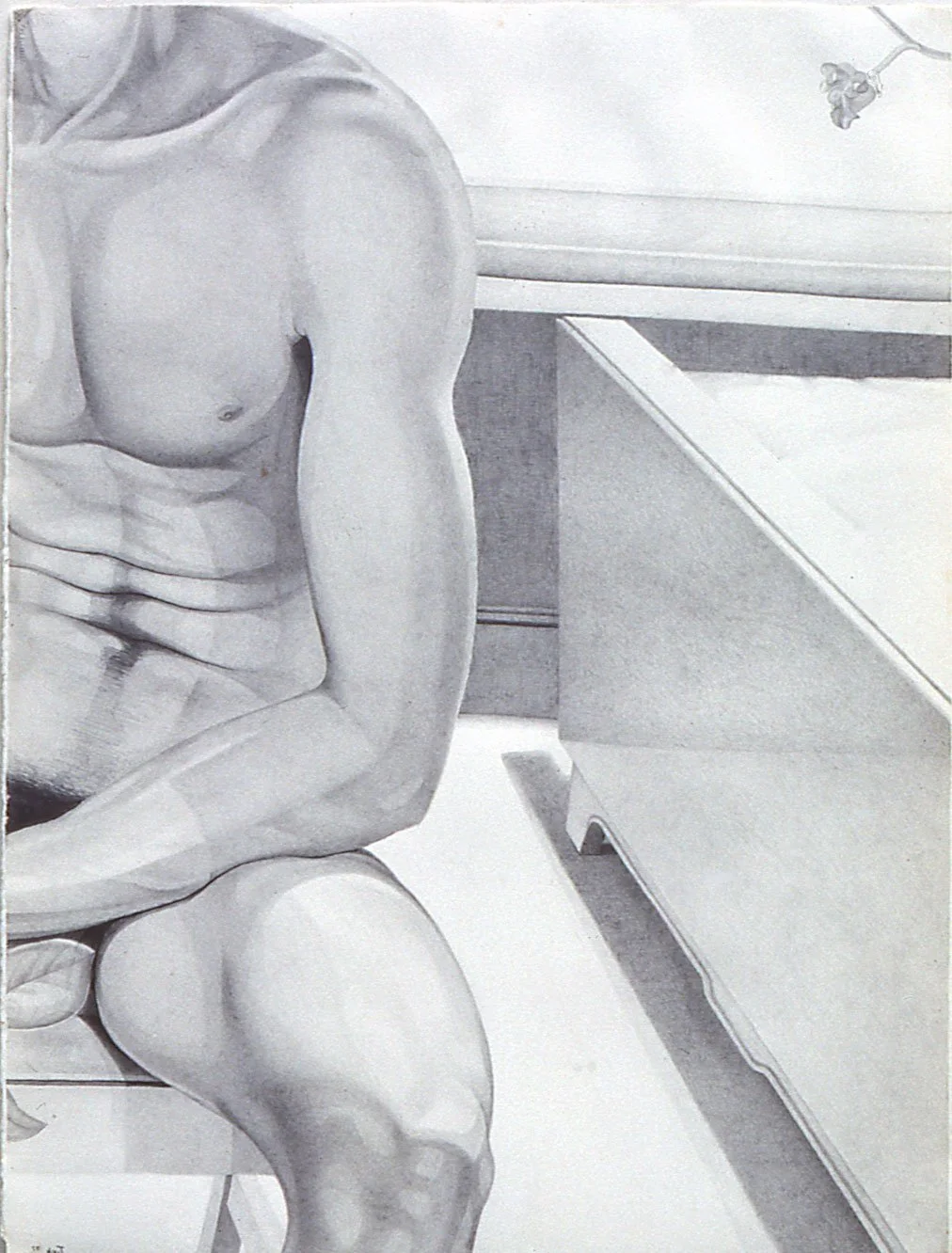
Man Figure (1976)

$1,820.00
Contact the Artist

A pivotal monochromatic study where contour, light, and continuation of form reach full maturity

In Man Figure (1976) I was arriving at the height of my early exploration into monochromatic light and shade on the human body. This drawing is one of the larger figurative works from that period, and it represents a moment when I understood that contoured edges were not simply boundaries — they were partners in bringing the figure to life.

I wanted the viewer to feel that the form doesn’t stop at the edge. The contour should imply the unseen back side of the body, the continuation of mass and volume beyond the paper’s surface. What happens at the edge matters just as much as what happens within the shadows and highlights. The edge becomes a hinge — a place where the visible turns into the imagined.

That’s why the cropping of the figure — removing the head and the remainder of the body — is not a loss but an understanding. The viewer senses the rest of the form because the drawing’s internal logic insists it exists. The light, the shading, the pressure of the contour all point to a body that extends beyond the frame.

This work marks a moment when I was no longer just describing the figure; I was animating it through the tension between what is seen and what must be known.

  • Dimensions: 12″ × 15″

  • Medium: Pencil on rag paper

A pivotal monochromatic study where contour, light, and continuation of form reach full maturity

In Man Figure (1976) I was arriving at the height of my early exploration into monochromatic light and shade on the human body. This drawing is one of the larger figurative works from that period, and it represents a moment when I understood that contoured edges were not simply boundaries — they were partners in bringing the figure to life.

I wanted the viewer to feel that the form doesn’t stop at the edge. The contour should imply the unseen back side of the body, the continuation of mass and volume beyond the paper’s surface. What happens at the edge matters just as much as what happens within the shadows and highlights. The edge becomes a hinge — a place where the visible turns into the imagined.

That’s why the cropping of the figure — removing the head and the remainder of the body — is not a loss but an understanding. The viewer senses the rest of the form because the drawing’s internal logic insists it exists. The light, the shading, the pressure of the contour all point to a body that extends beyond the frame.

This work marks a moment when I was no longer just describing the figure; I was animating it through the tension between what is seen and what must be known.

  • Dimensions: 12″ × 15″

  • Medium: Pencil on rag paper

In this piece, Tuck emphasizes the immediacy of the human body — its structure, its vulnerability, and its expressive potential. The figure’s stance and form suggest a moment suspended between motion and stillness, a hallmark of Tuck’s ability to capture psychological nuance through physical presence.

The restrained palette and focused composition draw attention to the figure’s internal world, encouraging viewers to consider the emotional and narrative possibilities embedded in posture and silhouette. “Man Figure” stands as a testament to Tuck’s commitment to the human form as a site of introspection and connection.