 Image 1 of 1
A foundational drawing where line, movement, and emotional presence first converge
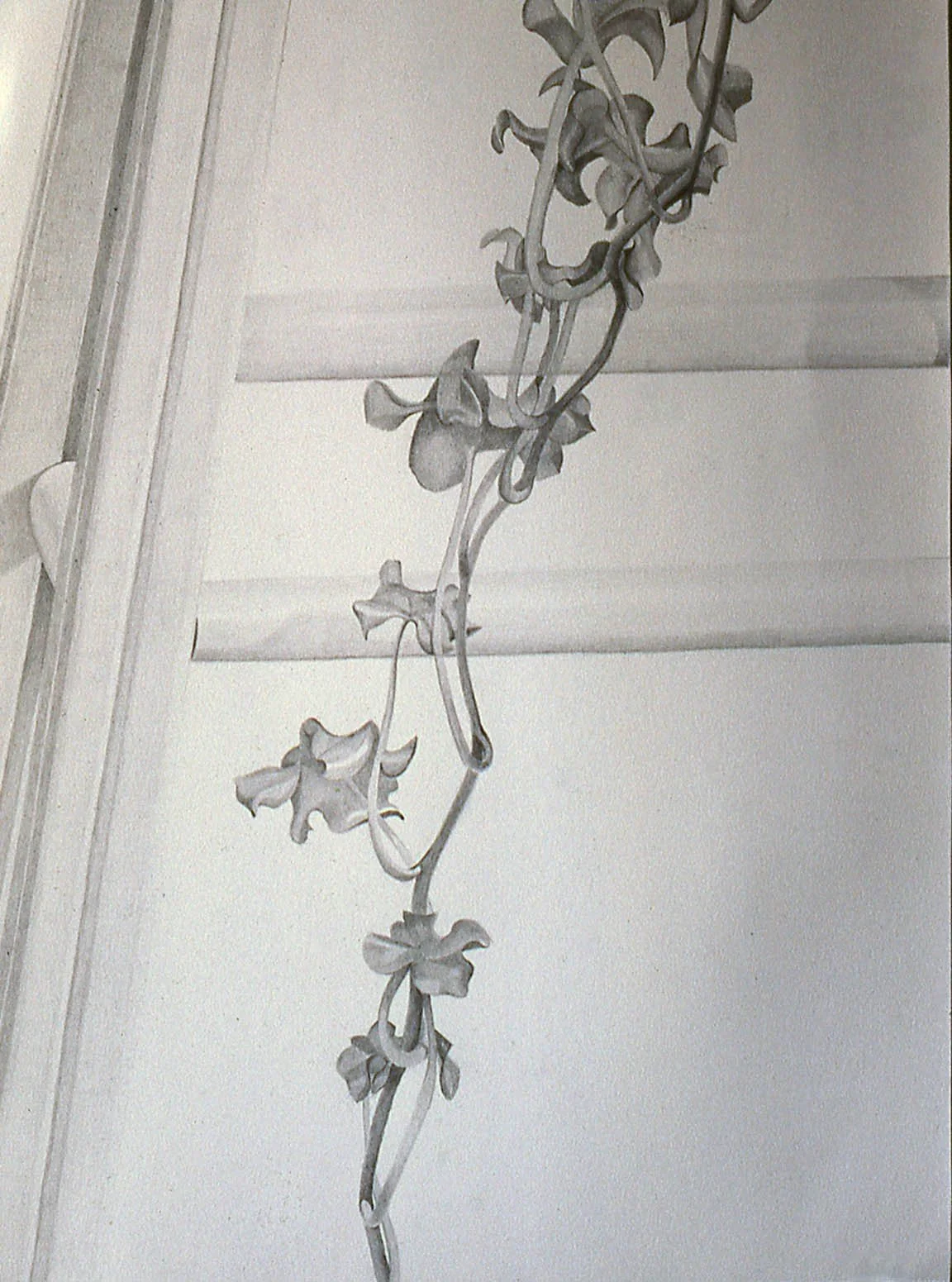
In Ivy and Stool (1978) I was still shaping the visual language that would become central to my Ivy Series. This early pencil drawing grew directly out of the disciplined figure‑drawing studies that formed the backbone of my training. Those descriptive line exercises — learning how contour reveals structure, how pressure shifts meaning, how a line can breathe — became the groundwork for how I approached objects.
The lightly dangling ivy vine offered something the figure never quite could: a chance to study subtle movement in space without narrative weight. Ivy doesn’t pose; it drifts, bends, and responds to gravity in ways that feel both delicate and emotionally charged. Drawing it allowed me to explore how objects interact with one another in a shared atmosphere — how a vine can hover near a stool leg and create a quiet tension, or how a simple curve of stem can suggest presence.
The stool provided the counterpoint: stable, architectural, a grounding form against which the ivy’s softness could be measured. Pencil was the perfect medium for this stage of my development. It let me translate what I had learned from the human figure into the realm of surface qualities, which would later become essential in works involving eggs, plants, and reflective objects.
Looking back, this drawing marks the moment when I began to understand that even the simplest objects carry emotional resonance — and that line alone can reveal it.
Dimensions: 8″ × 11″
Medium: Pencil on rag paper
A foundational drawing where line, movement, and emotional presence first converge
In Ivy and Stool (1978) I was still shaping the visual language that would become central to my Ivy Series. This early pencil drawing grew directly out of the disciplined figure‑drawing studies that formed the backbone of my training. Those descriptive line exercises — learning how contour reveals structure, how pressure shifts meaning, how a line can breathe — became the groundwork for how I approached objects.
The lightly dangling ivy vine offered something the figure never quite could: a chance to study subtle movement in space without narrative weight. Ivy doesn’t pose; it drifts, bends, and responds to gravity in ways that feel both delicate and emotionally charged. Drawing it allowed me to explore how objects interact with one another in a shared atmosphere — how a vine can hover near a stool leg and create a quiet tension, or how a simple curve of stem can suggest presence.
The stool provided the counterpoint: stable, architectural, a grounding form against which the ivy’s softness could be measured. Pencil was the perfect medium for this stage of my development. It let me translate what I had learned from the human figure into the realm of surface qualities, which would later become essential in works involving eggs, plants, and reflective objects.
Looking back, this drawing marks the moment when I began to understand that even the simplest objects carry emotional resonance — and that line alone can reveal it.
Dimensions: 8″ × 11″
Medium: Pencil on rag paper