A window where interior and exterior trade places, and the viewer becomes part of the scene
When I painted Inside/Outside–Outside/Inside–Cafe, I wanted the act of looking through a window to feel unstable — a moment where interior and exterior quietly exchange roles. Standing outside and looking in, I became aware of how the glass held both spaces at once, folding reflections and glimpses of the café into a single plane. The title hints at that reversal, that doubling, where the viewer has to consider their own position in relation to the scene.
I was exploring how thresholds can shift our sense of presence — how a familiar moment becomes psychologically charged when perception is reframed by light, reflection, and the tension of being both observer and participant. The restaurant figure standing in profile, showing only his back, reinforces that ambiguity. He is deliberately unidentified, a presence without identity, a body that anchors the space while withholding its story.
Inside, the red circular stool tops angles back into the room beside the diagonal thrust of a countertop, creating a subtle geometric rhythm. The overhead lights tilt toward a perceived three‑dimensional perspective, guiding the eye deeper into the interior. Hanging in front of the café window, a lighted oil lantern becomes a small but insistent marker of the threshold — neither fully inside nor outside.
The glass surface gathers everything: – the interior lights, – the standing figure, – the lantern, – the street scene behind, – and the faint reflection of another figure.
These layers never fully settle. They hover in a perceptual in‑between, where the viewer must decide what belongs to the café, what belongs to the street, and what belongs to the act of looking itself.
A window where interior and exterior trade places, and the viewer becomes part of the scene
When I painted Inside/Outside–Outside/Inside–Cafe, I wanted the act of looking through a window to feel unstable — a moment where interior and exterior quietly exchange roles. Standing outside and looking in, I became aware of how the glass held both spaces at once, folding reflections and glimpses of the café into a single plane. The title hints at that reversal, that doubling, where the viewer has to consider their own position in relation to the scene.
I was exploring how thresholds can shift our sense of presence — how a familiar moment becomes psychologically charged when perception is reframed by light, reflection, and the tension of being both observer and participant. The restaurant figure standing in profile, showing only his back, reinforces that ambiguity. He is deliberately unidentified, a presence without identity, a body that anchors the space while withholding its story.
Inside, the red circular stool tops angles back into the room beside the diagonal thrust of a countertop, creating a subtle geometric rhythm. The overhead lights tilt toward a perceived three‑dimensional perspective, guiding the eye deeper into the interior. Hanging in front of the café window, a lighted oil lantern becomes a small but insistent marker of the threshold — neither fully inside nor outside.
The glass surface gathers everything: – the interior lights, – the standing figure, – the lantern, – the street scene behind, – and the faint reflection of another figure.
These layers never fully settle. They hover in a perceptual in‑between, where the viewer must decide what belongs to the café, what belongs to the street, and what belongs to the act of looking itself.
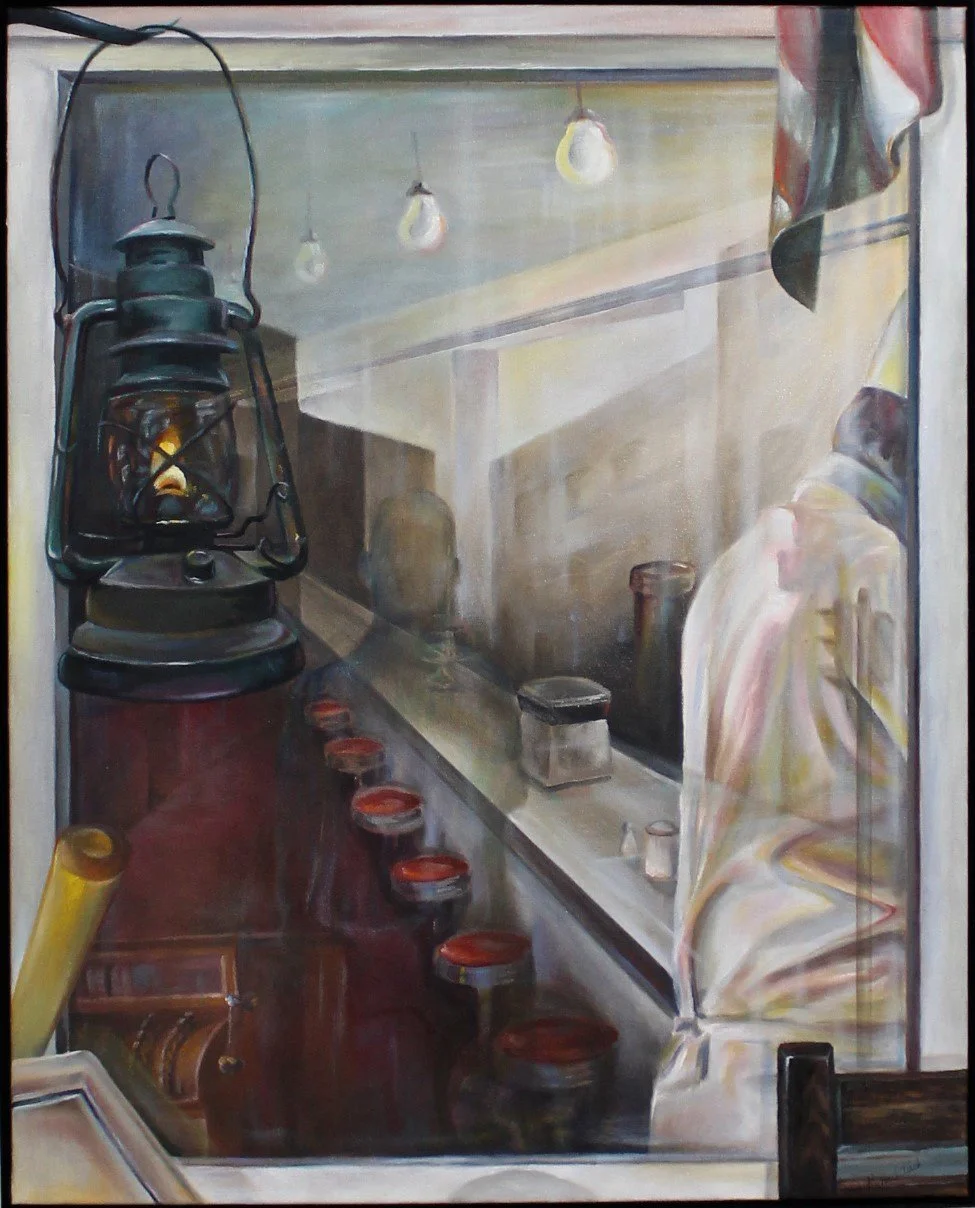 Image 1 of 1