A vertical figure compressed by the frame, where cloth, body, and paint share the same pulse
When I painted Woman Lying (Vertical), I was exploring how a figure could feel both present and partially withheld simply through the way it meets the edges of the canvas. The woman lies vertically on her stomach, her feet clipped at the top and her head partially clipped at the bottom, so the body feels continuous beyond the frame. That compression creates a quiet tension — a sense of the figure extending into unseen space.
The orange blanket wraps around her middle and drapes off to the left, slipping out of view. Its folds carry the weight of the form beneath: the color shifts, the shadows, the soft ridges of paint all describe her body without outlining it. I wanted the luscious layers of paint to do the work — to let the surface speak as strongly as the figure. The same plush handling carries into the white cloth beneath her, where the paint becomes almost sculptural.
Like Horizontal Woman, this painting uses a subtle trompe l’oeil sensibility — not to trick the eye, but to heighten the viewer’s awareness of how paint can hover between illusion and material fact. In both works, I was interested in how skin becomes paint, how the body can be felt through the surface rather than explicitly drawn.
A vertical figure compressed by the frame, where cloth, body, and paint share the same pulse
When I painted Woman Lying (Vertical), I was exploring how a figure could feel both present and partially withheld simply through the way it meets the edges of the canvas. The woman lies vertically on her stomach, her feet clipped at the top and her head partially clipped at the bottom, so the body feels continuous beyond the frame. That compression creates a quiet tension — a sense of the figure extending into unseen space.
The orange blanket wraps around her middle and drapes off to the left, slipping out of view. Its folds carry the weight of the form beneath: the color shifts, the shadows, the soft ridges of paint all describe her body without outlining it. I wanted the luscious layers of paint to do the work — to let the surface speak as strongly as the figure. The same plush handling carries into the white cloth beneath her, where the paint becomes almost sculptural.
Like Horizontal Woman, this painting uses a subtle trompe l’oeil sensibility — not to trick the eye, but to heighten the viewer’s awareness of how paint can hover between illusion and material fact. In both works, I was interested in how skin becomes paint, how the body can be felt through the surface rather than explicitly drawn.
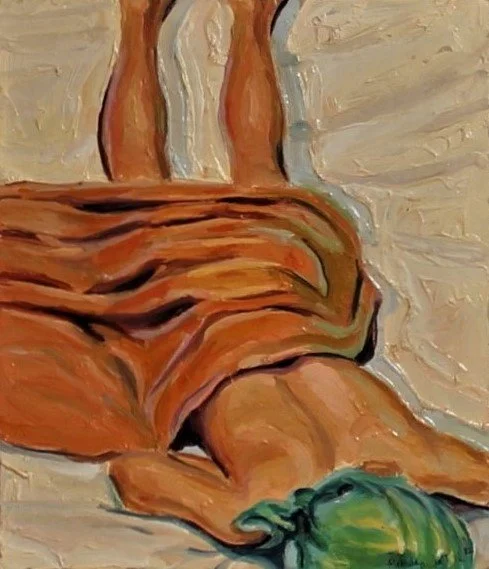 Image 1 of 1