A figure stretched across the canvas, where paint and body merge
When I painted Horizontal Woman, I wanted the figure to feel fully present yet partially withheld — a body stretched from edge to edge, clipped at the feet on one side and the head on the other. That compression creates a quiet pressure, as if the figure extends beyond the frame. The orange blanket lies vertically across her, its folds mostly upright, revealing hints of the form beneath. Those folds became a way to echo the body without describing it directly.
The paint is applied liberally, almost sculpturally, so the surface asserts itself as strongly as the figure. I was interested in how thick, fluid paint could blur the line between representation and material fact — how skin could become paint, and paint could become a kind of physical presence. There’s a subtle trompe l’oeil sensibility in the way the blanket’s folds and edges sit against the figure, but I wanted that illusion to stay understated, more felt than declared.
This work pairs closely with Vertical Woman, painted during the same period. Both explore how a single figure, partially cropped and wrapped in fabric, can become a study in surface, weight, and the tension between body and paint. They share the same interest in how a figure can be both
A figure stretched across the canvas, where paint and body merge
When I painted Horizontal Woman, I wanted the figure to feel fully present yet partially withheld — a body stretched from edge to edge, clipped at the feet on one side and the head on the other. That compression creates a quiet pressure, as if the figure extends beyond the frame. The orange blanket lies vertically across her, its folds mostly upright, revealing hints of the form beneath. Those folds became a way to echo the body without describing it directly.
The paint is applied liberally, almost sculpturally, so the surface asserts itself as strongly as the figure. I was interested in how thick, fluid paint could blur the line between representation and material fact — how skin could become paint, and paint could become a kind of physical presence. There’s a subtle trompe l’oeil sensibility in the way the blanket’s folds and edges sit against the figure, but I wanted that illusion to stay understated, more felt than declared.
This work pairs closely with Vertical Woman, painted during the same period. Both explore how a single figure, partially cropped and wrapped in fabric, can become a study in surface, weight, and the tension between body and paint. They share the same interest in how a figure can be both
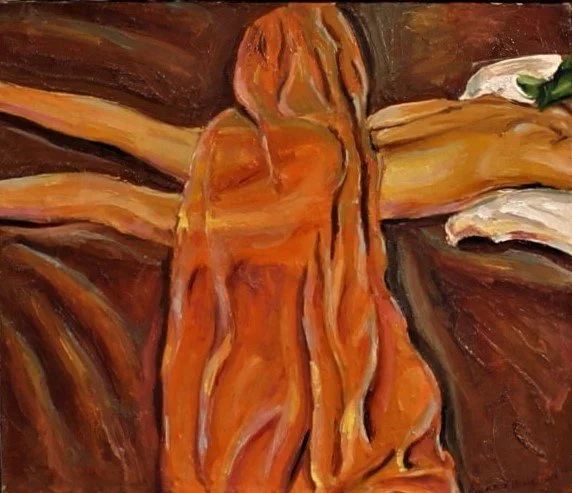 Image 1 of 1