 Image 1 of 1
A simple object pushed to the edge—light, refraction, and form becoming abstraction
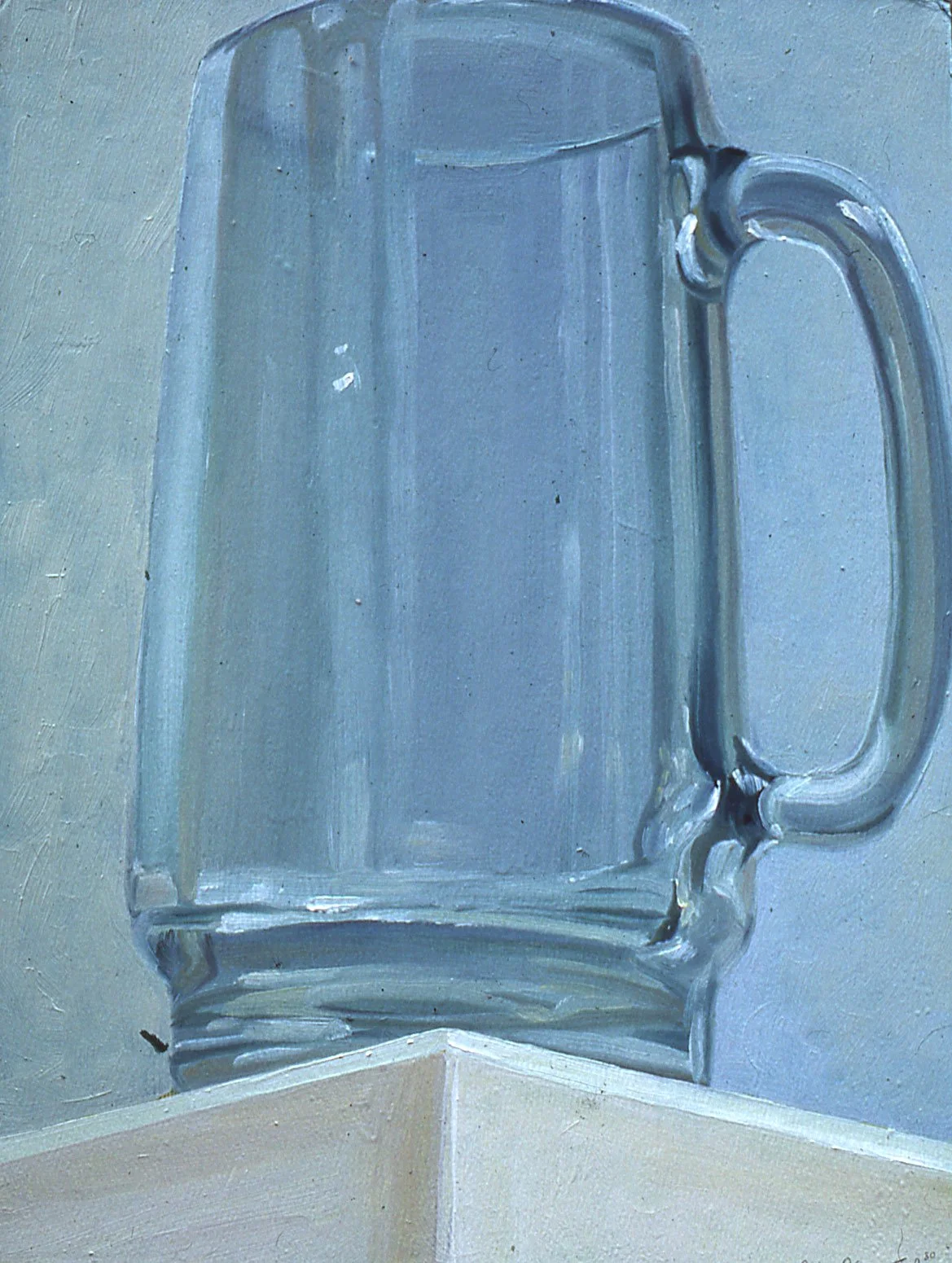
Glass Mug (1980) belongs to your Objects on the Edge group, a body of work where familiar items become vehicles for visual abstraction. In this piece, the everyday glass mug becomes a study in how light bends, refracts, and transforms a simple form into something structurally complex.
Glass, by nature, behaves like a prism. In this drawing, the mug’s isolation restricts the color range to soft blue and blue‑green tones, which glow through the transparent walls. The handle, with its curved thickness, pulls forward deeper hues—its bending form intensifying the color and giving the object a surprising visual weight.
I approached this mug the same way I approached the human figure: as a form whose edges, surfaces, and internal tensions could be pushed to the limits of the frame. Like the figure, the mug becomes a presence.
I repeated this exploration in Champagne Glass, placing the object tight and forward, its edges nearly touching the frame and its top rising above it. Both works crowd the picture plane, creating a sense of immediacy and pressure—objects that feel larger than their physical size.
In Glass Mug, the abstraction doesn’t come from distorting the object but from seeing it intensely: the way light moves through it, the way color concentrates in its curves, the way its edges assert themselves against the boundaries of the composition. It’s a quiet but confident demonstration of how a simple object can become a powerful visual event.
· Dimensions: 11″ × 14″
· Medium: Oil on matboard
· Framing: Custom-framed by me to complement my specific painting
aesthetic.
A simple object pushed to the edge—light, refraction, and form becoming abstraction
Glass Mug (1980) belongs to your Objects on the Edge group, a body of work where familiar items become vehicles for visual abstraction. In this piece, the everyday glass mug becomes a study in how light bends, refracts, and transforms a simple form into something structurally complex.
Glass, by nature, behaves like a prism. In this drawing, the mug’s isolation restricts the color range to soft blue and blue‑green tones, which glow through the transparent walls. The handle, with its curved thickness, pulls forward deeper hues—its bending form intensifying the color and giving the object a surprising visual weight.
I approached this mug the same way I approached the human figure: as a form whose edges, surfaces, and internal tensions could be pushed to the limits of the frame. Like the figure, the mug becomes a presence.
I repeated this exploration in Champagne Glass, placing the object tight and forward, its edges nearly touching the frame and its top rising above it. Both works crowd the picture plane, creating a sense of immediacy and pressure—objects that feel larger than their physical size.
In Glass Mug, the abstraction doesn’t come from distorting the object but from seeing it intensely: the way light moves through it, the way color concentrates in its curves, the way its edges assert themselves against the boundaries of the composition. It’s a quiet but confident demonstration of how a simple object can become a powerful visual event.
· Dimensions: 11″ × 14″
· Medium: Oil on matboard
· Framing: Custom-framed by me to complement my specific painting
aesthetic.