 Image 1 of 1
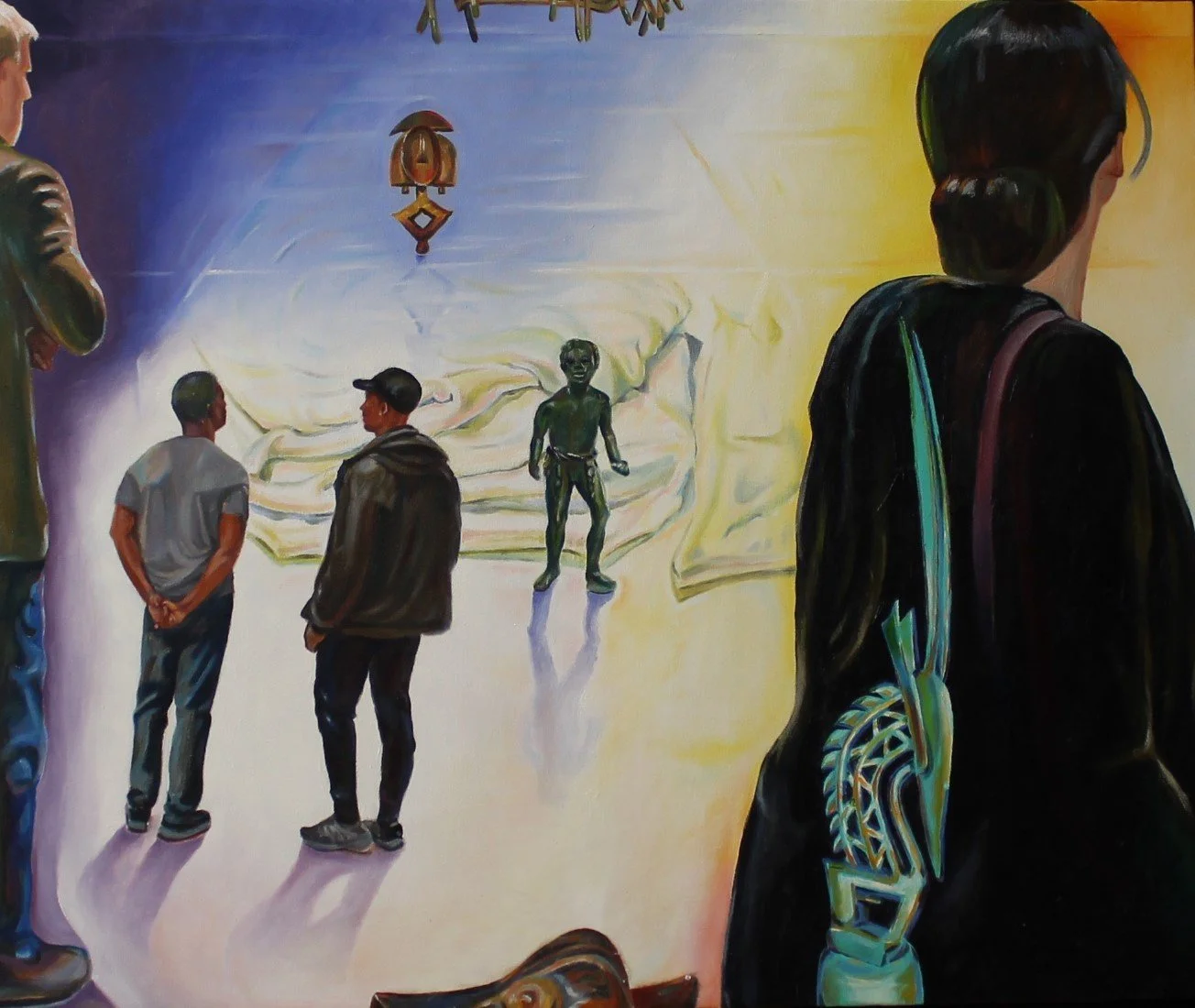
Peering, Ethiopian is a landscape built around distance, presence, and the shifting perception of identity through symbolic forms. At the center stands the image of a bronze Ethiopian figure, based on a sculpture from an internationally recognized museum. He rises before a backdrop of receding folds that resemble draped cloth, a surface that feels both material and imagined.
Above him, an African mask floats in open space, while two male figures occupy the middle ground between the distant sculpture and the foreground. On the left edge, a man in a coat stands close to the viewer, his vertical form extending from the top to the bottom of the picture plane.
The nearest figure—a woman seen from behind—peers into a bright red‑orange distance on the right side, opposite the coated man. Her black garment fills the right portion of the painting, rising from the lower edge to nearly three‑quarters of the height. Her dark hair merges with the garment, creating a single silhouette that becomes the backdrop for a Chi Wara headdress, its arched antelope form thrusting upward in sharp contrast.
Additional African artifacts float near the top and bottom edges, further denying any sense of stable, habitable space. The painting’s warm, radiant right side and deep blue left side resist naturalistic light, placing figures and objects within a deliberately surreal contradiction.
Rather than offering mirror‑based reflection, I wanted this work to invite a mental and symbolic reflection—an interior space where cultural memory, distance, and identity intersect.
· Dimensions: 30″ × 24″
· Medium: Oil on canvas
· Framing: Custom-framed by me to complement my specific painting
aesthetic.
Peering, Ethiopian is a landscape built around distance, presence, and the shifting perception of identity through symbolic forms. At the center stands the image of a bronze Ethiopian figure, based on a sculpture from an internationally recognized museum. He rises before a backdrop of receding folds that resemble draped cloth, a surface that feels both material and imagined.
Above him, an African mask floats in open space, while two male figures occupy the middle ground between the distant sculpture and the foreground. On the left edge, a man in a coat stands close to the viewer, his vertical form extending from the top to the bottom of the picture plane.
The nearest figure—a woman seen from behind—peers into a bright red‑orange distance on the right side, opposite the coated man. Her black garment fills the right portion of the painting, rising from the lower edge to nearly three‑quarters of the height. Her dark hair merges with the garment, creating a single silhouette that becomes the backdrop for a Chi Wara headdress, its arched antelope form thrusting upward in sharp contrast.
Additional African artifacts float near the top and bottom edges, further denying any sense of stable, habitable space. The painting’s warm, radiant right side and deep blue left side resist naturalistic light, placing figures and objects within a deliberately surreal contradiction.
Rather than offering mirror‑based reflection, I wanted this work to invite a mental and symbolic reflection—an interior space where cultural memory, distance, and identity intersect.
· Dimensions: 30″ × 24″
· Medium: Oil on canvas
· Framing: Custom-framed by me to complement my specific painting
aesthetic.