 Image 1 of 1
Oil on primed rag board and mounted in a real wood floater frame to accent its demonstrative action. Ready to hang hardware already attached.
A playful still life where gesture, scale, and modernist perception animate two humble vegetables
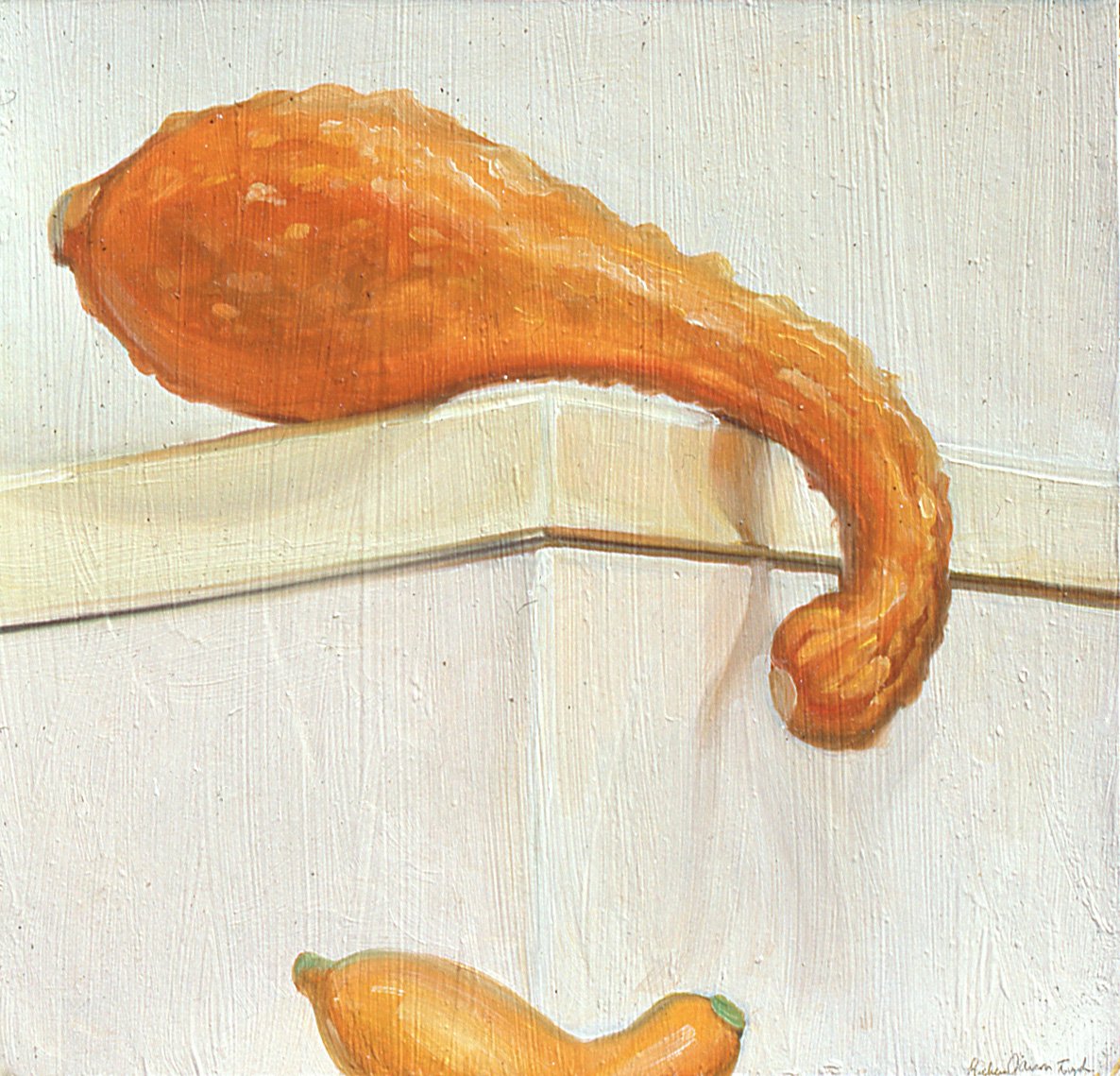
In Big Squash – Little Squash (1980) I was continuing the line of inquiry that had begun with Green Tomato — the idea that an everyday object, when isolated and given its own stage, can assert a kind of unexpected presence. The crookneck squash, with its curving, almost figurative form, seemed to command its own natural statement once placed in a deliberate setting.
What interested me here was the relationship between the two forms. Their gesture and size suggested a kind of shared vegetable narrative:
The big squash leans over the edge of a surface, its long neck reaching downward as if peering or bending toward something below.
The little squash lies nearby, its curved vine‑attachment end lifting upward, almost in response to the larger one.
That upward/downward exchange creates a subtle dialogue — a quiet drama of scale, posture, and orientation. It’s a still life, but it behaves almost like a small scene.
This was also a moment when I was thinking about the modernist movement, which begins with questions of perception, structure, and emotional perspective. Pop Art, by contrast, flips those concerns on their head, amplifying the bold, the graphic, the culturally loud. I found myself borrowing just enough of Pop’s exuberance and humor to energize the compositions, while keeping the subject matter rooted in my own world of modest, familiar objects.
There was a bit of playfulness in devising these vegetable settings — a recognition that even the simplest forms can carry personality, attitude, and a touch of wit when placed in the right visual conversation.
Dimensions: 12″ × 13″
Medium: Oil on matboard
Framing: Custom-framed by me to complement my specific painting aesthetic.
A playful still life where gesture, scale, and modernist perception animate two humble vegetables
In Big Squash – Little Squash (1980) I was continuing the line of inquiry that had begun with Green Tomato — the idea that an everyday object, when isolated and given its own stage, can assert a kind of unexpected presence. The crookneck squash, with its curving, almost figurative form, seemed to command its own natural statement once placed in a deliberate setting.
What interested me here was the relationship between the two forms. Their gesture and size suggested a kind of shared vegetable narrative:
The big squash leans over the edge of a surface, its long neck reaching downward as if peering or bending toward something below.
The little squash lies nearby, its curved vine‑attachment end lifting upward, almost in response to the larger one.
That upward/downward exchange creates a subtle dialogue — a quiet drama of scale, posture, and orientation. It’s a still life, but it behaves almost like a small scene.
This was also a moment when I was thinking about the modernist movement, which begins with questions of perception, structure, and emotional perspective. Pop Art, by contrast, flips those concerns on their head, amplifying the bold, the graphic, the culturally loud. I found myself borrowing just enough of Pop’s exuberance and humor to energize the compositions, while keeping the subject matter rooted in my own world of modest, familiar objects.
There was a bit of playfulness in devising these vegetable settings — a recognition that even the simplest forms can carry personality, attitude, and a touch of wit when placed in the right visual conversation.
Dimensions: 12″ × 13″
Medium: Oil on matboard
Framing: Custom-framed by me to complement my specific painting aesthetic.
Oil on primed rag board and mounted in a real wood floater frame to accent its demonstrative action. Ready to hang hardware already attached.