 Image 1 of 1
A figure exposed and obscured at once, held in an unstable field of contour and fracture
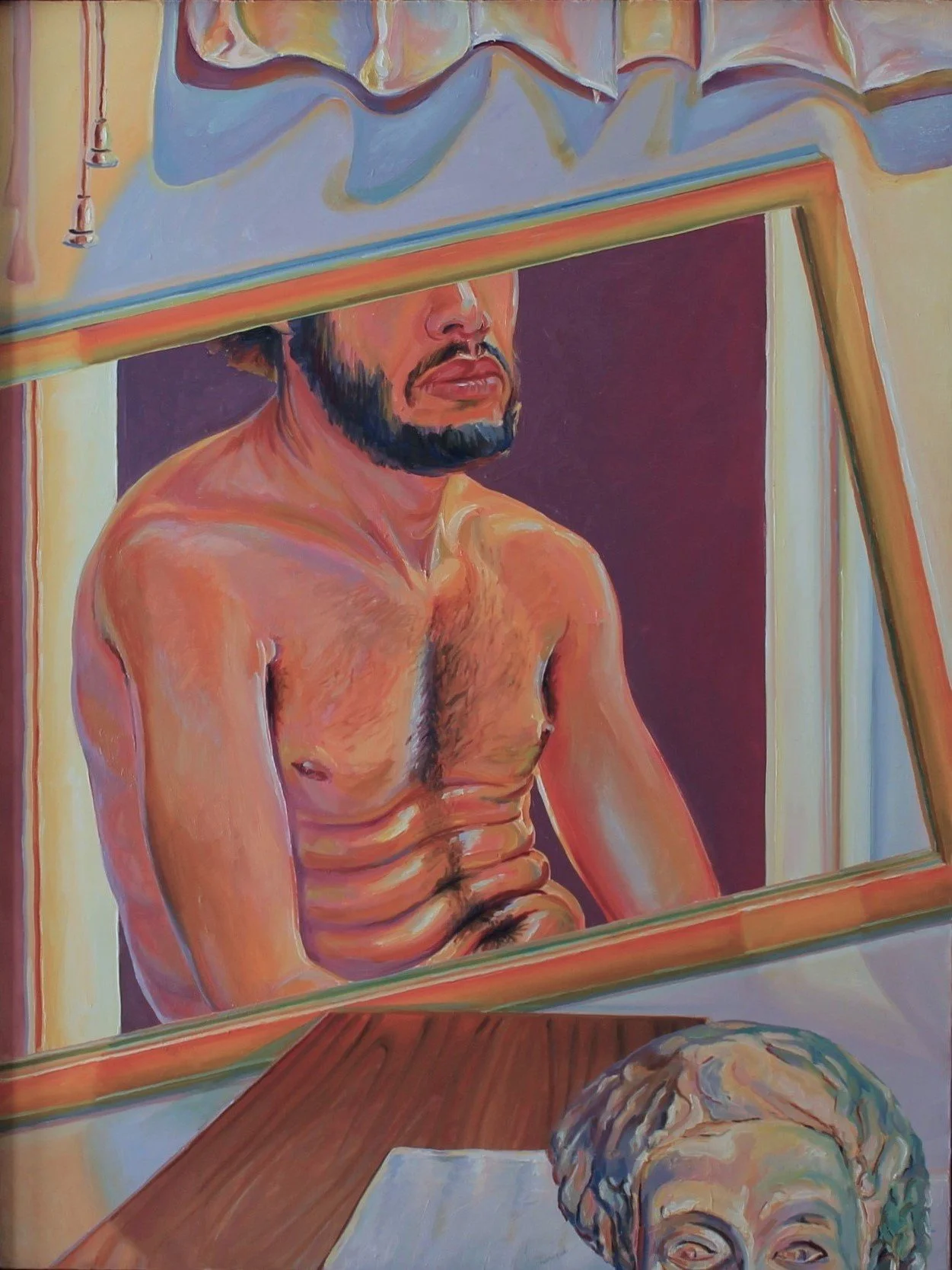
When I painted Bearded Man in Mirror and Head, I was working through a period where contour felt like the most direct way to express emotional states. The clipped, partially faceless torso let me explore presence through absence — how a body can feel exposed and obscured at the same time. His posture has an unattractive slump, and the small tease of chest hair only heightens the vulnerability of the pose.
From the top left, the end of a dangling cord interrupts the space, while the curved shadow of what may be a curtain runs across the upper edge. These intrusions were intentional: they destabilize the composition and keep the viewer from settling into a comfortable reading of the scene.
The reflected space adds another layer of imbalance. A ceramic head hovers at the edge of the frame, its presence both literal and symbolic. It doesn’t complete the figure; it complicates him. The abrupt edges, the peculiar objects, and the tension between what’s shown and what’s withheld were all part of my attempt to capture a psychological unease that never resolves.
The mirror itself — tilted at an unstable angle — becomes less about reflection and more about fracture. It breaks the space, distorts perception of the body, and turns the act of looking into something unsettled. In this painting, the mirror is not a tool for self‑recognition but a device for disorientation, a way to reveal the emotional instability beneath the surface.
Dimensions:
Medium: Oil on canvas
Framing: Custom‑framed by me to complement my specific painting aesthetic.
A figure exposed and obscured at once, held in an unstable field of contour and fracture
When I painted Bearded Man in Mirror and Head, I was working through a period where contour felt like the most direct way to express emotional states. The clipped, partially faceless torso let me explore presence through absence — how a body can feel exposed and obscured at the same time. His posture has an unattractive slump, and the small tease of chest hair only heightens the vulnerability of the pose.
From the top left, the end of a dangling cord interrupts the space, while the curved shadow of what may be a curtain runs across the upper edge. These intrusions were intentional: they destabilize the composition and keep the viewer from settling into a comfortable reading of the scene.
The reflected space adds another layer of imbalance. A ceramic head hovers at the edge of the frame, its presence both literal and symbolic. It doesn’t complete the figure; it complicates him. The abrupt edges, the peculiar objects, and the tension between what’s shown and what’s withheld were all part of my attempt to capture a psychological unease that never resolves.
The mirror itself — tilted at an unstable angle — becomes less about reflection and more about fracture. It breaks the space, distorts perception of the body, and turns the act of looking into something unsettled. In this painting, the mirror is not a tool for self‑recognition but a device for disorientation, a way to reveal the emotional instability beneath the surface.
Dimensions:
Medium: Oil on canvas
Framing: Custom‑framed by me to complement my specific painting aesthetic.